

- By Wrenlocal
- Choosing a Provider
Quick answer: a month-to-month local SEO contract is the safer default for a contractor, because you can leave the moment the work stops earning its fee. A 6 or 12 month term is not a scam by itself, but it only makes sense if the contract also says you own your Google Business Profile, domain and website, lists every fee, and spells out how you get out. The three things to settle before you sign: who owns what, what it costs to leave, and what you keep when you do.
This guide is general information for business owners, not legal advice. It covers the contract types you will see, the ownership checklist, the exact clauses to look for, the fees that trap people, red flags, 20 questions to ask, how to cancel (with an email you can copy), and what Google’s own rules say an agency must hand back.
- The contract types you will actually see
- Month to month vs a minimum term
- Who owns what: the checklist
- What Google requires of your agency
- The clauses to find before you sign
- Fees and auto-renewal traps
- Red flags
- 20 questions to ask
- How to cancel, step by step
- Cancellation email template
- If the agency will not hand things back
- Frequently asked questions
- Sources
The contract types you will actually see
- Month to month. You pay each month and can stop with a short notice period, often 30 days or the end of the billing month.
- Initial term, then rolling. A 3 to 6 month minimum, then month to month. A common middle ground.
- 6 to 12 month minimum. The most common retainer length agencies describe on their own sites. Several argue local SEO needs that long to show results. None of the pages we reviewed backed the claim with published data, so treat “6 to 12 months is standard” as an agency preference, not a rule.
- 12 to 24 months. Often paired with a lower monthly rate or a built website. The longer the term, the more the exit clause matters.
- Auto-renewing. Any of the above can renew for another full term unless you give written notice inside a window. This is where most of the real damage happens, so it gets its own section below.
Month to month vs a minimum term
| Minimum term (6 to 24 months) | Month to month | |
|---|---|---|
| Why a company prefers it | Predictable revenue and time for slow work to show | Fewer sales objections; it must earn the next invoice |
| Risk to you | Paying for months of work you are unhappy with, plus exit fees and auto-renewal | Stopping before the work has had time to pay off; sometimes a higher monthly rate |
| Risk to the company | Low | High: you can leave any month |
| What to check | Renewal window, early-termination fee, what happens to assets on exit | Setup fee, website buyout, notice period, whether “cancel anytime” is in the written agreement |
| Works best when | You have vetted the company, own every asset, and the contract has a performance exit | You are new to the company or want to judge the work month by month |
Neither structure is honest or dishonest on its own. Local SEO does take time, so a company asking for a few months is not suspicious. A company that will not put ownership and exit terms in writing is. For context, our own pricing is month to month with no setup fee, so you can see what a rolling agreement looks like in practice.
Who owns what: the checklist
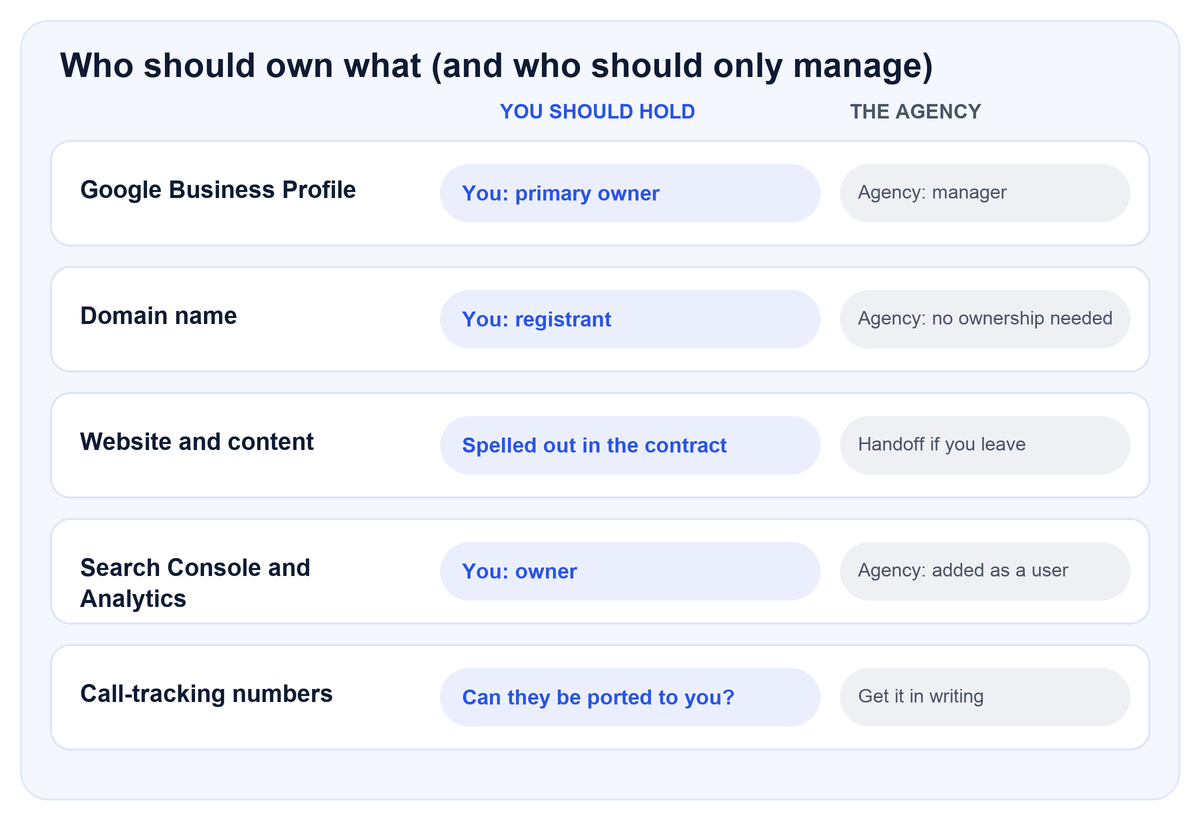
This is where contractors get stuck. Cancelling is easy when you own the pieces and painful when the agency does. Check each item yourself before you sign, and again before you give notice.
| Asset | Where to check | What “yours” looks like | Agency should have |
|---|---|---|---|
| Google Business Profile | Sign in to Google, search your business name, open the profile’s “People and access” list | You (a Google account you control) are Primary owner. Best practice: a second owner at your company too | Manager |
| Domain name | Your registrar login (GoDaddy, Namecheap, etc.) and a WHOIS lookup | Your company is the registrant and you can log in to the registrar | DNS access or a delegate login, not the registrant |
| Website files and content | The contract’s ownership clause; hosting login | The contract says the site, its content and its images are yours, or states the buyout price in writing | Admin access while the contract runs |
| Hosting | Who pays the host and whose name is on the account | You can get a full copy of the site on request | Admin access |
| Search Console and Analytics | Settings, Users and permissions / Property access | You are an Owner (Search Console) or Administrator (Analytics) | Full or Editor access under your property |
| Google Ads account | Ads account access settings | Account is in your name; you pay Google directly | Manager account linked to yours |
| Call-tracking numbers | The call-tracking provider’s account | The contract says numbers port to you on exit | Manages the account |
| Business listings and citations | Ask for the list of directories with logins | Logins use your email, not the agency’s | Access to update |
| Reviews | They live on the profile and the platforms | Follow the profile; keep the profile and you keep the reviews | Reply access via manager role |
Why the Google Business Profile matters most
Google’s help center explains the roles: owners can add or remove users and remove the profile; managers can edit the profile and reply to reviews but cannot add or remove users or remove the profile. A profile can have several owners but only one primary owner, who cannot drop their own access until primary ownership is transferred. One detail that catches people: for the first 7 days after someone is added as an owner or manager, they cannot remove other owners or transfer primary ownership. So if you are about to leave an agency and you are not yet an owner, get added now, not the week you give notice.
On the Local Search Forum, a thread on profile user practices in June 2026 described an agency that was primary owner, went out of business, and left the client holding manager access only. The forum’s advice matches Google’s: the business owner is primary owner, a second owner is added, agencies get manager access, and former agencies are removed. If you want the full setup walk-through, see our Google Business Profile checklist for contractors.
What Google requires of your agency
Most contractors do not know this exists. Google publishes a third-party policy that any agency managing Business Profiles has to follow. The parts that matter for your contract:
- You must keep ownership. The business must always remain an owner or co-owner of its profile. If a profile already exists, the agency should ask to be invited as a manager, not an owner.
- Handback within 7 business days. When you ask to end the relationship, the agency must let you disconnect and regain full control, and remove its own permissions, within 7 business days.
- No hostage-taking. Agencies must not hold a profile hostage for payment, pressure you to sign up, or claim a profile without your express consent.
- Fees in writing. If the agency charges to manage the profile, it must tell you in writing before it starts that Business Profile itself is free, and the fee must appear on your invoices.
- No guarantees. Agencies must not guarantee top placement or promise that your profile will always appear in Search or Maps.
If an agency breaks these rules, Google provides a form to report a third-party policy violation (linked in the sources). A contract clause that contradicts them is a reason to walk away.
The clauses to find before you sign
Read the exit terms before the sales deck. Find these sections in the actual document, and if any is missing, ask for it in writing.
| Clause | What it should say | What to watch for |
|---|---|---|
| Term | Start date, length, and whether it is month to month after the initial term | “Initial term” that quietly means 12 months with a 24-month renewal |
| Termination / notice | How many days’ written notice, where to send it, and that it takes effect at the end of the billing month | Notice only accepted by certified mail, or only “valid” once the agency confirms receipt |
| Auto-renewal | No renewal, or a renewal you must opt into, with a written reminder before the date | Renewal for a full new term unless you cancel 60 to 90 days before the end |
| Ownership of work product | You own the content, pages, images, links and data created for you, from the day they are created | Copyright kept by the agency; “license to use while active” |
| Accounts and access | You are owner of the Google Business Profile, Search Console, Analytics and Ads; the agency works as a manager | Accounts “managed by agency” with no owner named |
| Website and domain | You are the domain registrant. The site is yours, or the buyout price is stated in writing before you start | Buyout amount “to be determined”; domain registered under the agency |
| Handoff on exit | A list of what is handed over (site copy, logins, listing list, reports) and the deadline | No handoff clause, or “at agency’s discretion” |
| Fees | Monthly fee, every one-time fee, and every exit fee, with amounts | Early-termination fees of several months’ retainer; setup fees that are not explained |
| Deliverables and reporting | A plain list of monthly work and a monthly report you can check yourself | “Ongoing optimization” with nothing countable |
| Price changes | Written notice (30 days or more) and the right to cancel before an increase | Annual escalators with no exit |
| Removal of work | Nothing you paid for is removed when you leave | Agency reserves the right to take down pages, links or content |
| Guarantees | None. Results depend on your market | Any ranking or timeline guarantee |
Fees and auto-renewal traps
- Setup fee. Ask what it pays for and whether any part is refundable. Some companies charge none; ours does not on the SEO package.
- Early-termination fee. If you leave before a minimum term ends, what do you owe? Get the number. Some agencies add a fee of several months of the retainer for leaving early, so ask for the exact amount in writing.
- Website buyout. If the agency built your site as part of a monthly package, keeping it on exit may cost a one-time fee. That is a legitimate model as long as the amount is in writing before you start. A buyout you only learn about when you try to leave is not.
- Renewal window. A contract can say “30 days’ notice” and still renew for a year, because the 30-day window only opens once a year. Put the last day to cancel on your calendar the day you sign.
- The law on auto-renewal. The FTC’s 2024 “click-to-cancel” rule, which would have required cancellation to be as easy as signup, was vacated by the Eighth Circuit on July 8, 2025, before it took effect, on procedural grounds. A law firm’s summary says more than half of states have automatic-renewal laws, many as strict as the vacated federal rule. Whether one applies to a business-to-business SEO contract in your state is a question for a local attorney.
Red flags
| Red flag | Why it matters |
|---|---|
| A guaranteed #1 ranking or “page one in 90 days” | Google says nobody can guarantee a top ranking, and its third-party policy bars agencies from promising it. |
| A “special relationship” with Google or “priority submit” | Google lists these among the claims to be wary of. |
| Unsolicited calls or emails out of the blue | Google compares them to scam messages and advises caution. |
| Asks to be owner of your Google Business Profile | Google’s policy says you keep ownership and the agency works as a manager. |
| Will not show you every change made to your site | Google says anyone with access should be able to explain each change; you are responsible for what they do. |
| Domain or hosting in the agency’s name | If you cannot log in, you cannot leave with it. |
| Vague deliverables | You cannot tell what you are paying for each month. |
| Exit terms they will not discuss | The exit clause tells you what the agency expects to happen. |
| Fake or rented listings and reviews | In May 2026 the FTC and Illinois sued a home-services company accused of creating thousands of fake local business listings and fabricated five-star reviews. The case is pending; the allegations show what regulators are now going after. |
| Cancellations ignored or billed after notice | A 2008 Washington State settlement with an SEO seller required it to disclose contract terms up front, honor cancellations and stop unauthorized billing. Regulators treat unprocessed cancellations as a violation. |
If you believe an SEO company deceived you, Google points to the FTC at ftc.gov or 1-877-FTC-HELP. Your state attorney general’s office handles auto-renewal and billing complaints.
20 questions to ask
Ask these on the sales call and keep the answers. The good companies will not mind.
- Who will be the primary owner of my Google Business Profile?
- Whose name is the domain registered under, and can I log in to the registrar?
- Who owns the website and its content if I leave? If there is a buyout, what is the amount, in writing?
- Will I be an owner on Search Console, an administrator on Analytics and the account holder on Google Ads?
- What is the minimum term?
- Does the contract renew automatically? How many days before the end must I cancel, and will you remind me?
- Is there a setup fee, and what does it cover?
- Is there an early-termination fee? How much?
- What exactly do I get each month? Can I see a sample report?
- Will you share every change you make to my site and why? (Google suggests asking this.)
- What happens to the pages, links and content you built if I cancel?
- Can my call-tracking number be ported to me?
- What is handed over when I leave, and within how many days?
- Can I see examples of work for businesses in my trade and in a market like mine?
- How long have you been doing this, and who will actually do my work?
- What results should I expect, over what timeframe, and how do you measure them?
- Do you follow Google’s Search Essentials and its Business Profile third-party policy?
- Do you outsource any of the work, and to whom?
- Who do I talk to, and how fast do you reply?
- What would make you tell me to stop paying you?
How to cancel, step by step
- Read the clause first. Find the notice period, the renewal date, the method of notice and the address it must go to. Do not rely on what the account manager says; use the document.
- Secure access before you say anything. Confirm you are primary owner of your Google Business Profile, you can log in to your registrar and host, and you own Search Console and Analytics. If you are not yet an owner on the profile, ask to be added now; remember the 7-day wait before a new owner can be made primary.
- Download what is yours. Export reports, the citation list, website content and images, and your Analytics and Search Console data.
- Give written notice by the method the contract names, and also by email so you have a dated copy. Ask for written confirmation of the end date.
- Request the handoff in the same message: a full copy of the site, every login, removal of the agency’s access, and transfer of any numbers.
- Watch the billing. If a charge lands after the agreed end date, dispute it with your card issuer with the notice attached.
- Remove their access from the profile, Analytics, Search Console, Ads and the host once the handoff is complete.
Do not just stop paying inside a minimum term. Walking away from a signed contract can leave you owing the balance; if the agency has not delivered what it promised, document the gaps in writing first and talk to an attorney about ending it for breach.
Cancellation email template
Subject: Notice of cancellation: [Business name], account [number]
Hello [agency contact],
This is written notice that [Business name] is ending its agreement for local SEO services, dated [contract date], under the termination section ([section number]). Per the [30]-day notice period, our last day of service is [date]. Please do not bill us for any period after that date, and please confirm the end date in writing by [date, a few days out].
Within the handoff period in our agreement (and within 7 business days per Google’s Business Profile third-party policy), please:
- Confirm that [your name/email] is primary owner of our Google Business Profile and remove your users.
- Send a full copy of our website (files, database, images and text) and the hosting and domain logins, or confirm the domain is registered to us.
- Send the list of business listings you built, with logins.
- Transfer ownership of our Search Console, Analytics and Google Ads accounts to [email] and remove your access.
- Port call-tracking number(s) [numbers] to us.
- Confirm that no pages, content or links you created will be removed.
Thank you for your work. [Your name, title, phone]
Keep it factual. Send it from the email on file, keep the sent copy, and follow up on the end date in writing if you hear nothing within a few business days.
If the agency will not hand things back
- Google Business Profile. Sign in with your own Google account, find the business at business.google.com/add and use “Request access.” Google emails the current owner, who has 3 days to respond. If there is no response, you may be offered the option to verify and claim the profile yourself. If the request is denied, reply to Google’s denial email with proof of your affiliation (license, utility bill, phone bill) to appeal. You can also report the agency through Google’s third-party policy violation form. Service-area businesses use the Business Profile contact form instead, with “Transfer ownership of listing” as the issue. A 2023 Local Search Forum thread about an agency refusing to return a profile with 48 reviews was pointed to exactly this route: request, appeal, report.
- Domain. If the agency is the registrant, you need its cooperation or a dispute with the registrar. Registrars have their own dispute processes, so ask yours what proof it needs. This is the single asset most worth settling before you sign.
- Website. If the contract says the site is yours, request a full copy in writing and set a deadline. If it says the agency owns it, you are looking at the buyout clause or a rebuild. Your Google Business Profile, reviews and listings survive a rebuild as long as the domain stays yours.
- Billing after cancellation. Dispute the charge with your card issuer, file with your state attorney general, and file at ftc.gov.
Our own terms are built so none of this comes up: month to month, no setup fee, cancel in writing at any time with the cancellation taking effect at the end of the billing month, and you always keep your domain, your Google Business Profile, your Google Ads account and the listings we built. The website is built and hosted by us as part of the package; if you leave and want to keep it, there is a one-time $1,000 buyout fee, which we also put in writing before you start, and either way you get a copy of your text and photos. The current wording is on our terms page, and how it works shows what happens in the first weeks.
Frequently asked questions
Most use a written agreement, and many ask for a 6 or 12 month minimum. Some, including us, work month to month. “No contract” usually still means a written agreement with no minimum term, which is what you want: the paperwork protects you too.
Agencies most often describe 6 to 12 months, with 3-month minimums and month-to-month plans also common. We found no published survey that makes any of these a standard, so judge the length by what the contract gives you in return: ownership, a clear exit and a stated price.
For most contractors, yes, because the risk sits with the agency rather than with you. The honest trade-off is that some companies charge more per month for it. A 12-month term with a performance exit, no auto-renewal and full ownership can be fair too; a 12-month term without those is not.
Follow the notice clause exactly, secure your accounts first, send written notice with a requested end date and handoff list, and keep every message. The template above covers it. If you are inside a minimum term, ask an attorney before you stop paying.
Not under Google’s third-party policy. The business must keep ownership, and when you ask to end the relationship the agency must let you regain full control within 7 business days. If it refuses, request access through Google, appeal with proof, and report the violation.
Whatever the contract says. If you paid a build fee, the contract should say the site and content are yours. If the site came “free” with a monthly package, the agency usually keeps it unless you buy it out, so get the buyout amount in writing before you start. Your domain should be yours in every case.
Both exist and both are negotiable. Ask what the setup fee buys and whether it is refundable. An early-termination fee of several months’ retainer is a sign the contract is built to keep you, not to serve you.
A fair contract says the work done for you stays in place, so ask for that clause. Rankings can slip over time if the profile, reviews and site stop being maintained while competitors keep going. Results vary by industry, city and local competition.
Not currently. The rule was vacated in July 2025 before it took effect. State auto-renewal laws still apply, and some are strict, but whether one covers your business contract depends on your state. Ask a local attorney.
Yes. Google’s best practice and its policy for agencies both say you own the profile and the agency works as a manager. There is no task a manager cannot do that an agency legitimately needs.
Want to see where you stand before talking to anyone? Request a free ranking report. Our Google Business Profile management page lists exactly what we do each month, and our pricing page lists what you pay and what you own.
Sources
- Google Business Profile Help: third-party policies (ownership, 7-business-day handback, fees, no guarantees)
- Google Business Profile Help: owner and manager roles, primary ownership, 7-day restriction on new users
- Google Business Profile Help: request ownership of a profile (3-day response window)
- Google Search Central: Do you need an SEO? (questions to ask, warning signs, FTC contact)
- FTC press release, May 11, 2026: FTC and Illinois sue company over fake home-repair listings and reviews
- Greenberg Traurig: Eighth Circuit vacates FTC’s click-to-cancel rule (July 8, 2025); state auto-renewal laws still apply
- Washington State Attorney General, April 2008: settlement with an SEO seller over cancellation terms and unauthorized billing
- Local Search Forum, June 2026: GBP users best practices
- Local Search Forum, February 2023: former agency holding a client’s profile
Last reviewed October 13, 2026.