

- By Wrenlocal
- Google Maps Rankings
Quick answer: to rank higher on Google Maps, fix the two things Google lets you change. Raise relevance with the right primary category, a full services list and true hours. Raise prominence with a steady flow of real reviews and links from real local websites. You cannot change distance from the searcher, and Google says you cannot pay for a better local rank.
Below, every step is ordered by evidence and effort, and each one is tagged: Google says (a Google help page), Tested (someone changed one thing and measured it) or Expert opinion (a survey of specialists). Most guides mix those three together. The last part covers what does not work and what breaks Google’s rules.
Last reviewed October 13, 2026. We re-read Google’s help pages and the Whitespark survey on that date. Google rewrites its pages without notice, so check the linked page before you rely on a detail.
- How Google decides who shows up
- Three kinds of evidence
- The checklist, in order of evidence and effort
- What does not work, and what breaks the rules
- Why you rank at home but not in the next town
- If you are not showing at all
- How to check your rank properly
- How long it takes
- Frequently asked questions
- Sources
How Google decides who shows up
The “map pack” is the block of three businesses with a map that Google shows for local searches. Google’s help page on local ranking names three things:
- Relevance: how well your Business Profile matches what the person searched for.
- Distance: how far your business is from the person searching.
- Prominence: how well known your business is. Google says this is also based on how many websites link to you and how many reviews you have, and that more reviews and positive ratings can help.
The same page says verifying your business can make it more likely to appear, and that complete, accurate information helps customers and matching. It also says: “There’s no way to request or pay for a better local ranking on Google.” Ads and Local Services Ads are separate, labeled placements. If you are weighing ads against ranking, see Local SEO or Google Ads: which should a contractor start with?
Three kinds of evidence
- Google says. It is written on a Google help page, or a Google spokesperson said it publicly.
- Tested. Someone changed one thing on real listings and measured the result. Useful, but the samples are usually small, and a few are correlation studies.
- Expert opinion. The best-known source is the Whitespark 2026 Local Search Ranking Factors report, published November 6, 2025. 47 local search specialists scored 187 factors. It is informed opinion, not a measurement of Google.
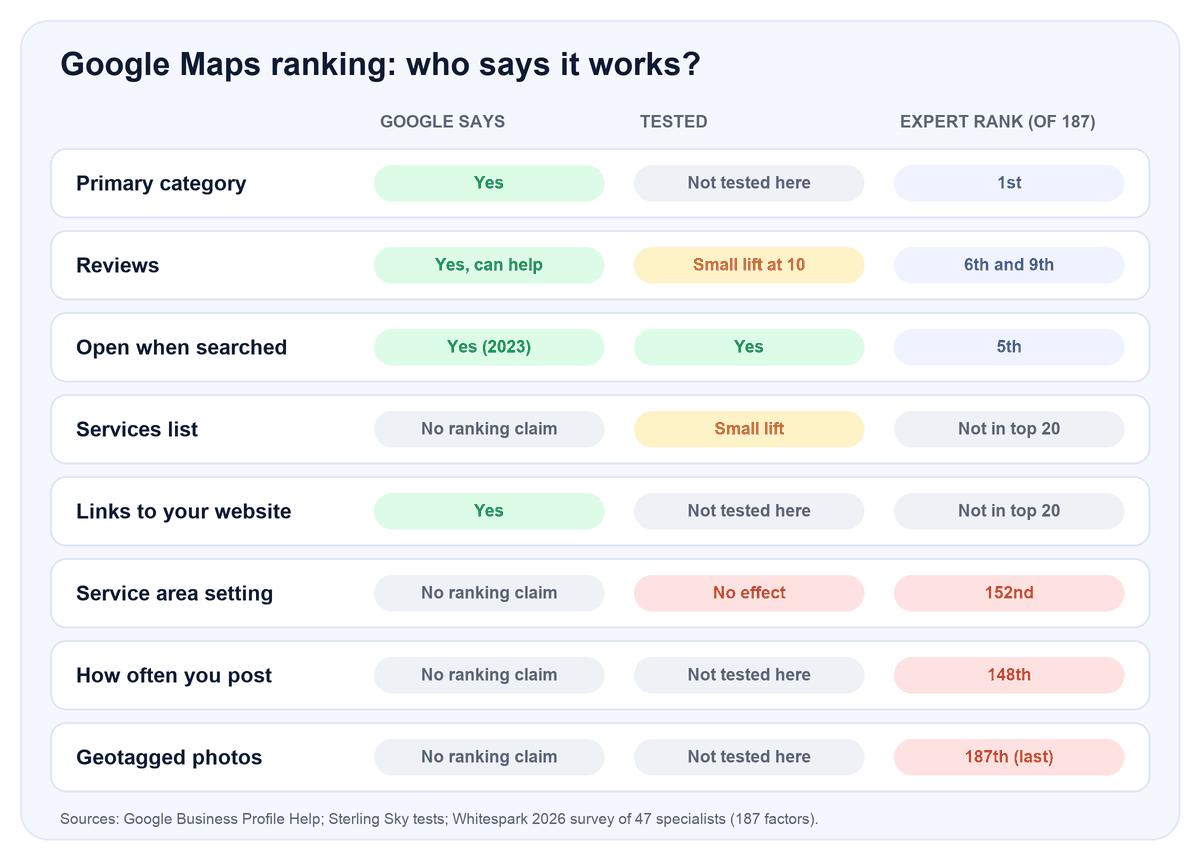
The picture shows the pattern. Experts rank your primary category first of 187, and Google confirms categories affect ranking. Posts (#148), service area settings (#152) and geotagged photos (#187, last) sit at the bottom, and they are the things owners are most often sold.
The checklist, in order of evidence and effort
This order is our judgment of how much each step moves you for the time it takes. It is written for a contractor who travels to customers. Do steps 1 to 4 first. They cost little and have the strongest backing.
1. Make sure you are verified, not suspended, and not duplicated
Google says. Verified businesses are more likely to appear, and there should be one profile per business. A suspended or duplicate profile holds back everything below. If yours is suspended, use Google’s appeals tool once, add documents whose name and address match the profile, and do not create a new profile for the same business. Details are in Why you are not in the Google Maps top three.
2. Set the primary category to the job you most want calls for
Google says, and experts rank it #1. Google’s category page says the categories you choose affect your local ranking. You get one primary category, so pick the specific one. A company that mostly installs patios should not sit under a broad contractor category. Google warns that adding or editing a category can ask you to verify again, so change it once and deliberately.
3. Add extra categories only for services you really offer
Google says to add categories for special departments or services, and not to pick one for every product or service. Its guidelines say to use as few as possible. Experts rank additional categories #8.
4. Ask every customer for a review, the allowed way
Google says more reviews and positive ratings can help your ranking, and it gives no target number. Google’s own tip is to ask customers to use a review link or QR code.
Tested, small sample. In a 2025 test of three businesses, moving from 9 reviews to 10 gave a small visible lift, and in three others moving from 10 to 11 did not. Treat that as a hint, not a rule. A larger 2025 correlation study of 8,186 home-service businesses in 200 cities found that reviews received recently and reviews with written text lined up with better “near me” rank. That study shows correlation, not cause.
Expert opinion. Experts rank high ratings #6, review count #9, review recency #11 and a sustained flow of reviews rather than bursts #14.
How to ask without breaking the rules: ask every customer, with the same message, soon after the job, and send the link by text. Do not offer anything in return. Do not ask only the people you think are happy. Both are banned (see below).
5. Make the profile complete, and keep your hours true
Google says complete, accurate details such as hours, category and attributes help. Experts rank completeness #16.
Google says (a Google spokesperson, December 2023) it has long used “openness” in local ranking and that it “recently became a stronger signal” for generic searches, and it might change. Experts rank “open at time of search” #5. List the hours you really answer the phone. Do not claim 24 hours when you are not available; Google reportedly advised against that.
6. Fill in your services list
Tested, small effect. A testing firm reports that adding services to a profile can lift rank for those service searches within about 24 to 72 hours, with the effect varying by industry and market. Their write-up gives no sample sizes, so treat the size of the gain as unproven. Add every service that applies, with plain descriptions.
7. Give the website a clear page for each main service
Google says websites that link to you are part of prominence. Expert opinion: the title tag (#17) and headings (#20) of the page your profile links to are mid-level factors, and so is local keyword relevance of your content (#18). The 2025 study above found only a slight correlation between substantive page content and rank. A real page per service that names the towns you serve in plain sentences is worth doing for customers anyway. See our Google Business Profile management for how we set this up.
8. Earn links from real local sources
Google says the number of websites linking to you is part of prominence, with no detail on how many or from where. Suppliers, trade associations, your chamber of commerce and local sponsorships are honest places to start. It is slow.
9. Get the main business listings right, and stop there
Tested, modest. In a 2024 test, building 50 listings each for a dentist and a handyman raised organic rankings at first but did not improve their local pack rank. Fix your name and phone on the major sites because wrong details lose customers, but do not expect map movement. Whitespark’s group weights are only shown in a chart image, so we do not quote a weight for listings.
10. Add real photos of real jobs
Google says photos show what you offer. It makes no ranking claim. The 2025 study found recent photos helped in visual trades like restaurants and salons but not consistently elsewhere. Photos help a customer pick you, which is reason enough.
11. Reply to every review
Google says replying shows you value customers and can help you stand out. It does not say replies raise rank. Keep replies short and specific, and do not use them to advertise.
12. Set your service area honestly, then move on
Google says you can have up to 20 service areas within about two hours’ drive, and that setting it helps people find your profile. Tested: a testing firm tracking its own listing reports that the service area does not change rank, and rank follows the address you verified with. Experts rank it #152 of 187.
13. Post updates for customers, not for rank
Google makes no ranking claim we could find for posts, and experts rank posting frequency #148. One practitioner team reports minimal ranking effect from posts in its own tests. Post if it helps customers who open your profile.
What does not work, and what breaks the rules
Several shortcuts do work for a while, which is why competitors use them. Each one below breaks a published Google rule.
| Shortcut | Google’s rule | What can happen |
|---|---|---|
| Adding services or a city to your business name | The name must be your real-world name, with no service or location details | Suspension, or Google strips the extra words and rank can drop |
| A P.O. box, remote mailbox or virtual office in the city you want | Not acceptable or not eligible | Suspension |
| A second profile for the next town | One profile per business | Suspension |
| A discount or gift for a review | Incentives for reviews are prohibited | Google may block new reviews, unpublish existing ones for a period, and show a public warning |
| Asking only happy customers, or hiding unhappy ones | Selectively soliciting positive reviews is prohibited | Same penalties |
| Reviews from staff, family or yourself | Conflict of interest and fake engagement | Same penalties |
| A service area drawn across the whole state | About two hours’ drive from your base | Guideline violation, and no ranking benefit |
| Paid or fake clicks to boost engagement (“CTR manipulation”) | Not an official tactic. Practitioners disagree on whether it holds up | One forum thread from February 2026 describes gains that fade when stopped and a suspension risk raised by other members |
Keyword-stuffed names are the hard one. In a test, adding a keyword to a business name raised rank, and experts rank keywords in the name #3. It is still against the rules. When Google removed keywords from two listings, one fell from position 1 to 7 and another from 4 to 5. On a trade forum in June 2026, an owner said edit suggestions against a competitor’s stuffed names were ignored, rejected or reverted, and a long-time member called it a losing battle. The clean route is to actually register and use a name, and to win on reviews and categories instead.
“Nothing works” is a common complaint. Usually it means one of three things: the problem is distance, not effort; the profile has an eligibility issue; or a competitor is using a shortcut you will not copy. Only the first two are in your hands, and the next sections cover them.
Not worth your time: embedding a map on your site, geotagging photos, and paying for hundreds of listings. We found no Google statement that any of these raises rank, and experts rank geotagged photos last of 187.
Show your address. We do not recommend hiding it, even for a service-area business. Google’s guidelines say service-area businesses without customers at their address should hide it. In our experience, after managing dozens of Google Business Profiles, hidden-address profiles get far fewer calls and far less traffic than ones that show it, and tests from others point the same way. A hidden-address profile can still rank; it is much harder to turn into jobs. The address has to be a real place you operate from, never a PO box or virtual office, and the choice is yours.
Why you rank at home but not in the next town
Google measures distance from the person searching, and rank follows the address you verified with. You are usually strongest near home and weaker further out. Experts rank proximity to the searcher #2.
What you can do from one address:
- Raise relevance and prominence, so the area where you compete grows.
- Win normal website results in a nearby town with a real page about your service there. A forum reply from a Whitespark representative said service-plus-city pages help organic results but have little effect on map rank.
- Go after specific service searches, where fewer nearby competitors are relevant.
- Use ads for towns you cannot reach on the map. Ads are bought by area.
- Open a real, staffed location there. It is the only route to a second profile that fits the rules.
What you cannot do within the rules: move your rank by redrawing your service area, borrow an address, or expect the top three across a whole metro from one address in a competitive trade. Read your own result first with How to Read a Google Maps Ranking Map.
If you are not showing at all
Ranking low and not appearing are different problems. The usual causes of not appearing are an unverified or suspended profile, a duplicate, a category that does not match the search, searching from too far away, and being closed at that moment. Work through them in order with our seven-step check.
How to check your rank properly
Searching from your own phone tells you little. Google estimates the searcher’s location from the device, IP address, saved places and past activity, so you see the result for the one spot where you are nearest. A customer two towns over sees a different list.
Run the same search from many points across your service area and put the results on a map. A scan is a snapshot of one moment, and it measures rank, not calls. For calls, use the performance report in your own profile. It shows searches, views, calls, directions and website clicks, but not rank position.
How long it takes
Google gives no timeline. The only timings we can source are small ones: services edits reported to move rank in about 24 to 72 hours, and verification review that can take up to five business days. Reviews and links build slowly. We explain what to expect in How long does local SEO take for a contractor? Results vary by industry, city and local competition.
If you would rather have all of this done for you, our local SEO package covers the profile, the business listings and the contractor website design that the map pulls from. We have also written it out for plumbers, HVAC companies and roofers, since each trade has its own ranking quirks.
Frequently asked questions
No. Google says there is no way to request or pay for a better local ranking. Ads and Local Services Ads are separate, labeled placements.
Google gives no number. It says more reviews and positive ratings can help. One small test saw a lift at the tenth review and none at the eleventh, and recent reviews seem to matter more than the total.
It depends on your current count and average, and it is simple arithmetic. Multiply your average by your review count, then add 5 for each new 5-star review and divide by the new total. Do this before deciding how many to ask for.
Google’s page does not say it does, and a testing firm found it does not. Rank follows the address you verified with.
Only if it is your real, registered name. Tests show it can raise rank, but Google’s guidelines prohibit it and list suspension as the consequence.
Google does not say they do, and experts rank post frequency #148 of 187. Post for customers, not for rank.
Google says prominence is partly based on how many websites link to you. Experts also rate your profile’s landing page title and headings as mid-level factors.
Google does not list it. Experts rank HTML name, address and phone matching your profile #15. Keep your details the same everywhere because wrong details lose customers.
Sometimes at its edges, rarely across it in a competitive trade. Distance from the searcher is a core factor, and mailboxes and virtual offices are not allowed.
Report it with evidence, but expect it to be slow. Forum owners report edits being reverted and reports going unanswered for months. Spend your effort on the factors you control.
Sources
- Google Business Profile Help, Tips to improve your local ranking on Google (re-read October 13, 2026)
- Google Business Profile Help, Guidelines for representing your business on Google
- Google Business Profile Help, Choose a category for your Business Profile
- Google Business Profile Help, Manage your service areas
- Google Business Profile Help, Read and reply to reviews
- Google Business Profile Help, Restrictions for fake engagement
- Google Business Profile Help, Suspended profiles and appeals
- Google, Prohibited and restricted content (reviews policy)
- Whitespark, 2026 Local Search Ranking Factors (47 specialists, 187 factors, published November 6, 2025; expert opinion)
- Sterling Sky, review count test (April 30, 2025), near-me study of 8,186 businesses (November 5, 2025), business name test (August 9, 2023), service area test, hidden address test, services test and listings test (September 13, 2024)
- Search Engine Journal, Google confirms business openness as a local ranking factor (December 15, 2023)
- Local Search Forum, competitor keyword stuffing thread (June 2026), CTR thread (February 2026) and service-area thread (January 2023)
Results vary by industry, city, and local competition.