

- By Wrenlocal
- Guides
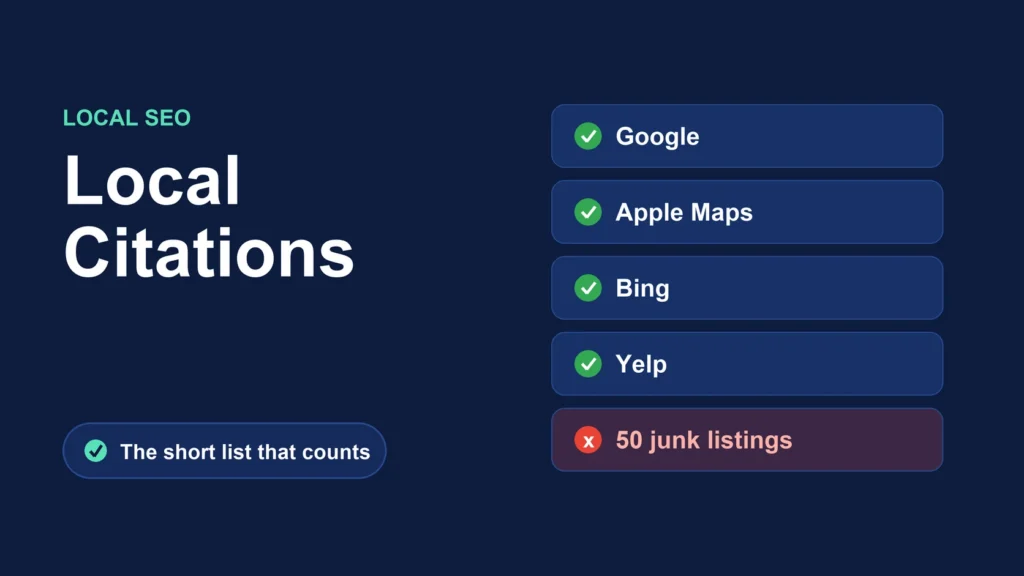
Quick answer: a local citation is any mention of your business name, address and phone number (NAP) on another website, such as Yelp, Apple Maps or a trade directory. Contractors still need a small set of correct listings, because wrong details cost you calls. But dozens of extra listings are not a way to climb Google Maps: in a 2024 test, 50 new citations did not move the local pack rankings for either business tested. Results vary by industry, city, and local competition.
Search for “local citations” and almost every result tells you to build as many as you can. The evidence says something more careful. Below we cover what citations are, what Google itself says about them, what the one controlled test we could find actually measured, which listings are worth your time as a contractor, and a 30-minute check you can run today. If you want someone else to handle it, we say what to ask before you pay.
- What is a local citation?
- Structured and unstructured citations: what is the difference?
- What does Google say about citations?
- What did the 50-listing test show?
- What do local search specialists say?
- Which listings does a contractor actually need?
- What are data aggregators, and do you need to deal with them?
- What has to match, and what does not?
- What about the address if you work from home?
- Worked example: bulk package or short list?
- A 30-minute listing check you can do yourself
- Should you pay someone to build citations?
- Frequently asked questions
- Sources
What is a local citation?
A citation is a place on the internet that shows your business name, address and phone number. Yelp is a citation. So is your Apple Maps listing, your Better Business Bureau page, a chamber of commerce member list, and a local newspaper article that mentions your company and phone number. BrightLocal, which publishes a widely used citation handbook, describes citations as online mentions that help establish a local business’s presence on the web and calls them “foundational” to local SEO (page last updated October 2025).
The short version of why they exist: customers use many apps and sites to find a contractor, not just Google. Each one has its own record of your business. If that record is wrong, a customer can end up calling a phone number you stopped using or driving to an address you moved out of.
Structured and unstructured citations: what is the difference?
People in the local search trade split citations into two kinds. You will see both words in agency proposals, so it helps to know them.
- Structured citations are listings in a directory with set fields for name, address, phone and category. Yelp, Apple Maps, Bing Places, Facebook, the Better Business Bureau and trade directories are structured.
- Unstructured citations are mentions in normal writing, such as a news story, a blog post, a supplier’s “where to buy” page or a sponsor list. You do not fill in a form. Someone writes about you.
Whitespark’s 2026 Local Search Ranking Factors survey (published November 6, 2025; 47 local search specialists; 187 factors) scores both. In the local pack list, the quality and authority of unstructured citations ranked 64th and the quality and authority of structured citations ranked 49th. The quantity of structured citations ranked 110th. In plain words: the specialists surveyed rated a few good listings and a few real mentions above a large pile of listings.
What does Google say about citations?
Google’s own help page on improving local ranking says local results are “mainly based on relevance, distance, and popularity” (Google uses the word “prominence” in the longer explanation). It says prominence draws on outside information, including how many websites link to your business, along with reviews and ratings. The page we opened does not tell you to build a number of directory listings, and it does not name citations as a ranking factor. That does not prove citations have zero effect. It means Google has not told contractors that listing count is a lever, so anyone selling it as one is going beyond what Google says.
What Google does ask for is complete and accurate business information. That is the part of citations that helps you: the same correct name, phone and address wherever people look.
What did the 50-listing test show?
The most direct test we found was published by Sterling Sky, a well-known local search agency, on September 13, 2024. It is a small test, so read it as one data point and not a law.
- Setup: 50 citations were built at once for each of two clients, a dentist and a handyman.
- Organic rankings (normal Google results): both clients saw an initial increase after the listings went in.
- Local pack rankings (the map results): no improvement for either client.
- Indexing: for the dentist, 26 of the 50 citations were still indexed by Google after one month and only 2 after six months. For the handyman, only 2 of 50 were indexed after six months.
- Caveat from the author: the citations were created and then left alone, not actively maintained. Generic directories may offer little long-term value, while industry-specific directories can be more useful but often require paid listings that standard citation packages do not include.
- Author’s conclusion: citations may affect organic rankings more than local pack rankings, and from several years of testing the author finds that about 10 to 20 citations is usually the most Google keeps indexed.
Why this matters for a contractor: most of your calls come from the map results. If listings do not move the map and Google drops most of them from its index within months, a long list is paying for something that does not last.
Two honest limits. First, it was two businesses, and a handyman is a service-area business like many of our readers, but a single test cannot tell you what happens in your city. Second, the test does not say citations are useless. It says that adding many of them did not lift the map.
What do local search specialists say?
| Source | What it says | How to read it |
|---|---|---|
| Google Business Profile Help | Local ranking rests on relevance, distance and prominence; prominence includes links, reviews and ratings. | No claim that listing count helps. |
| Sterling Sky test (2024) | 50 citations, no local pack gain, 2 of 50 indexed after six months. | Small test, but controlled and recent. |
| Whitespark 2026 survey | Citation consistency on Google, Bing and Apple Maps ranked 28th of 187 local pack factors; quantity of structured citations ranked 110th. | Correct beats numerous. |
| BrightLocal handbook | Citations are “foundational”; their weight as a ranking factor “has notably fluctuated”; unlikely to directly influence sales. | Support, not a driver. |
| Ahrefs guide (June 2020) | “Far from the be-all and end-all”; quality over quantity; paid citation tools probably not worth it for most. | Older article, but the same direction. |
| Local Search Forum thread, “Citations in 2026” | Members say a core set still matters; mass-buying hundreds has been ineffective for years. | Opinions from practitioners, not data. |
The pattern is consistent across sources with very different motives: a short, accurate set of listings is worth having, and volume is not the point. The one place the weight looks stronger is consistency on the big three map sources (Google, Bing and Apple Maps), which is exactly where a contractor should spend effort first.
Which listings does a contractor actually need?
Start with the places customers and map apps already use, then add a few that fit your trade. This is our recommended order, drawn from the sources above and from what we set up for clients. It is a priority list, not a Google requirement.
| Priority | Listing | Why it earns a spot |
|---|---|---|
| 1 | Google Business Profile | The listing behind your place on Google Maps. It matters more than every other listing combined. See our Google Business Profile checklist for contractors. |
| 2 | Apple Maps | What iPhone users see in Maps and hear from Siri. Apple lets businesses claim and manage a Maps listing, and the page we opened lists it among the platform’s features. |
| 3 | Bing Places | Bing search and maps, including many work computers. It also feeds other products. |
| 4 | Yelp | Customers check it. A Local Search Forum member noted Yelp feeds data to other map sources, so a wrong Yelp listing can spread. |
| 5 | Facebook business page | Named in the forum thread and in BrightLocal’s page as an established place customers trust. |
| 6 | Better Business Bureau | A free listing that many customers look at before they hire. A forum moderator suggested adding it. |
| 7 | Your trade directories | The few directories your own customers use for your trade and area. This is where Sterling Sky says the value can sit, though it may cost money. |
| 8 | Local mentions | Chamber of commerce, supplier “find an installer” pages, sponsor lists. Real mentions, not forms. |
That is roughly ten places, which lines up with the 10 to 20 range Sterling Sky says Google tends to keep indexed. Everything after that is a diminishing return.
What are data aggregators, and do you need to deal with them?
Data aggregators are companies that collect business details and pass them on to many directories and apps. BrightLocal’s page (updated July 2026) says there are “less than a handful” in the US and names Foursquare, Data Axle (formerly Infogroup), TransUnion Digital Business Profile (formerly Neustar Localeze), GPS Network and the YP Network. It adds a warning: not every listing or placement is guaranteed, because aggregators work more like a marketplace.
Two practical points from that page. TransUnion’s Digital Business Profile requires a paid subscription, listed at $99 per year per business profile. And Data Axle follows USPS address formatting, so match it. For a small contractor, the takeaway is not “buy every aggregator.” It is “make sure your details are right at the source, then check where they show up.” Whitespark’s survey ranks consistency on data aggregators 85th of 187, well below consistency on the primary map sources.
What has to match, and what does not?
NAP consistency is the part of citations that is simple and worth doing. Ahrefs says minor variations are not a major concern: “Beanies Coffee Shop” versus “Beanies” is probably fine if the address, phone and website match. Our own rule of thumb:
| Does not matter | Does hurt |
|---|---|
| “Street” and “St” | An old phone number that no longer reaches you |
| “Suite” and “Ste” | An address you moved out of |
| “LLC” or no “LLC”, if the rest matches | A different business name, for example after a rebrand |
| Capital letters | Two or more listings for the same business on one site |
Ahrefs also reports a BrightLocal finding that 80% of consumers lose trust in a local business when they see incorrect or inconsistent contact details or names. We are repeating that figure as Ahrefs reports it. The simple lesson stands either way: a wrong phone number on a listing is a lost call.
What about the address if you work from home?
This is where contractors get stuck, because citations ask for an address. Be honest about what Google says and what we have seen.
- Google’s help pages say service-area businesses that do not serve customers at their address should hide it on their Business Profile. That is Google’s rule, and the choice is the owner’s.
- In our experience managing dozens of profiles, profiles that show an address get far more calls and traffic than profiles that hide it. That is our experience, not a Google rule.
- Whatever you choose, the address has to be a real place where your business operates. Never use a PO box or a virtual office.
- Keep it consistent. If your Google profile hides the address but a directory shows your home address, you have a mismatch to manage on purpose, not by accident.
- Some directories are stricter. In the Local Search Forum thread, a home-based electrician said Apple refused a Maps listing without a commercial location, and other members shared workarounds. Those are individual reports, not Apple policy, so check Apple’s current rules before you submit.
Worked example: bulk package or short list?
Here is the arithmetic, using only numbers we found on pages we opened. BrightLocal’s citation handbook shows a starting price of $2 per citation for its build service. Other sellers price differently, so use this as a yardstick, not a quote.
- Bulk route: 50 citations at $2 each is $100 at the starting price. In the Sterling Sky test, 2 of 50 were still indexed after six months. That works out to about $50 for each citation Google still showed, and none of them moved the map.
- Short route: about 10 listings you create or fix yourself cost nothing but time (roughly the 30-minute check below plus filling in forms). If you add one paid industry directory, that is a choice you make on purpose, for a directory your customers use.
The point is not that $100 is a lot of money. It is that the bulk route buys the thing the test found does not work, and the short route buys the thing every source agrees on: correct details where customers look. If you are paying a monthly fee, ask where the 50 listings are indexed and which ones sent you a call.
A 30-minute listing check you can do yourself
- Write your exact business name, phone number, website and address (or service area) in one note. This is your master copy.
- Search your business name plus your city in Google, and look at the first two pages. Note every listing.
- Open Google Business Profile, Apple Maps, Bing Places, Yelp, Facebook and the Better Business Bureau. Compare each to your master copy.
- Fix wrong phone numbers and addresses first, then old business names.
- Look for duplicates (two Yelp pages, two Bing listings). Claim the right one and report the duplicate.
- Search your phone number alone. Old numbers on old sites are the ones that send calls to the wrong place.
- Add the one or two trade directories your customers use. Skip the rest.
- Put a reminder on the calendar to repeat this after any move, rebrand or number change.
Want a second pair of eyes? Our free Google Maps ranking report shows where you stand on the map today, so you can see whether listings are even your problem. Wrong details are one cause of a weak map position, but they are rarely the biggest one. Our guide on why you are not in the Google Maps top three walks through the bigger ones.
Should you pay someone to build citations?
Sometimes. If your business has moved, changed its name or changed its phone number, the old details are still sitting on dozens of sites, and cleanup is a real job. Paying for that can be worth it. Paying for dozens of new listings as a ranking tactic is the part the evidence does not support.
Questions to ask any provider:
- Which exact sites will you submit to, and can I see the list before you start?
- Are the listings in my business’s name, and do I hold the logins? Some services keep listings in sync for a yearly fee and the details can revert when you stop. (More on contract terms in our month-to-month guide.)
- How many are still indexed after one and six months?
- Do you remove duplicates and fix wrong data, or only add new ones?
- Will you promise ranking gains from citations? (If yes, the Sterling Sky test says to be careful.)
How we handle it: business listings are built, corrected and checked every month as part of our local SEO service, and they are created in your business’s name with the logins held by you. We do not sell listings as a way to rank. Details are on our business listings page. For a business with years of messy data, we offer a one-time six-week citation cleanup, with current pricing on the pricing page. See also what is included in a fully managed local SEO plan and Google Business Profile management. If you would rather talk it through, you can book a call.
Frequently asked questions
It is any mention of your business name, address and phone number on another website. A Yelp page, an Apple Maps listing and a chamber of commerce member page are all citations.
They help less than many sellers claim. Whitespark’s 2026 survey of 47 specialists ranks citation consistency on Google, Bing and Apple Maps 28th of 187 local pack factors and the quantity of structured citations 110th. In the 2024 Sterling Sky test, 50 new citations did not improve local pack rankings. Correct listings are a foundation, not a shortcut. Results vary by industry, city, and local competition.
There is no official number. Sterling Sky’s testing found that about 10 to 20 is usually the most Google keeps indexed. For most contractors, about ten correct listings (Google, Apple, Bing, Yelp, Facebook, BBB and a few trade or local sites) cover what customers actually use.
Start with Google Business Profile, Apple Maps, Bing Places, Yelp, Facebook and the Better Business Bureau. Then add the one or two directories your own customers use for your trade and area, and real local mentions such as chamber of commerce pages.
Yes, for the details that change what a customer does: the phone number, the address and the business name. Small formatting differences such as “St” versus “Street” are not a concern. A wrong phone number is a lost call.
Yes. The main listings are free to claim and fix, and the 30-minute check above covers the steps. Pay only for cleanup if you have years of old or duplicate listings, and ask to see the site list first.
Sources
- Sterling Sky: How many citations does a small business need? (September 13, 2024)
- Whitespark: 2026 Local Search Ranking Factors (published November 6, 2025)
- Google Business Profile Help: Tips to improve your local ranking on Google
- BrightLocal: Local Citations Handbook (updated October 2025)
- BrightLocal: What are data aggregators and how do they help local SEO (updated July 2026)
- Ahrefs: Local citations guide (June 25, 2020)
- Local Search Forum: Citations in 2026 (practitioner discussion)
- Apple Business: managing a business listing on Maps