

- By Wrenlocal
- Guides
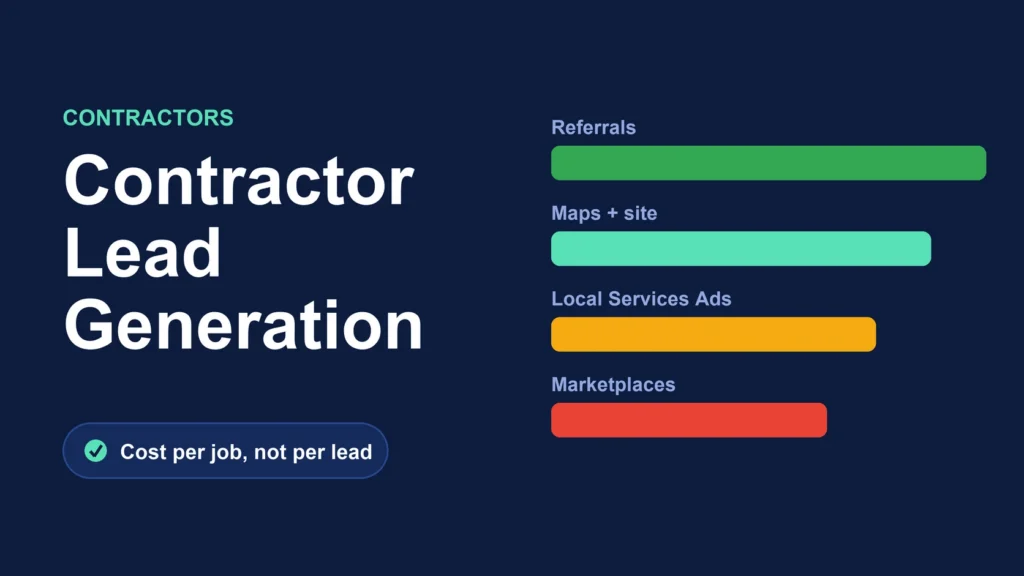
Quick answer: contractors get leads from four places: referrals and repeat customers, their Google Business Profile and website (local SEO), paid Google ads and Local Services Ads, and shared lead marketplaces such as Angi, HomeAdvisor and Thumbtack. LocaliQ’s 2026 benchmarks put the median cost per lead for home services at $90.92, and it runs from about $94 for electricians to about $228 for roofing. What a lead really costs you is the cost per booked job, which depends on how many leads you close. Results vary by industry, city, and local competition.
Most pages on this topic are lists of lead websites. This one is built around the number that matters: what you pay for each job you win. We compare the sources by who owns the lead, how fast it starts, what it costs and where it goes wrong, then give you a worked example and a table you can fill in with your own numbers.
- What counts as a lead, and which number to track?
- Where do contractor leads come from?
- What do leads cost in 2026?
- Worked example: cost per lead versus cost per job
- Shared leads: what to know before you pay
- How do Local Services Ads charge?
- Where does local SEO fit?
- What mix makes sense at different stages?
- The cheapest lead is the one you already paid for
- How to choose a lead generation company
- Frequently asked questions
- Sources
What counts as a lead, and which number to track?
A lead is a person who has asked you for work: a phone call, a form, a message or a booking request. Not every lead is a customer. Some are wrong numbers, outside your area, or looking for a free quote on a job you do not do.
Track three numbers for every source, not one:
- Cost per lead = what you spent divided by the number of leads.
- Close rate = booked jobs divided by leads.
- Cost per job = what you spent divided by the number of booked jobs. This is the one that decides whether a source works.
A $40 lead that closes one time in ten costs you $400 a job. A $120 lead that closes one time in three costs you $360. The cheaper lead is the more expensive job.
Where do contractor leads come from?
| Source | How you pay | Who gets the lead | Speed | Where it goes wrong |
|---|---|---|---|---|
| Referrals and repeat customers | Your time, a thank-you, a follow-up | You | Slow to build, steady | Hard to scale; you cannot buy more on demand |
| Google Business Profile and website (local SEO) | Monthly fee or your own time | You | Months | Slow start; rankings are never guaranteed |
| Google Local Services Ads | Per valid lead, within a budget you set | You (Google shows a few businesses) | Fast, after approval | Approval steps; you must answer fast; some leads are poor |
| Google Ads (search) | Per click | You | Fast | Clicks cost money whether or not they call; needs good tracking |
| Lead marketplaces (Angi, HomeAdvisor, Thumbtack) | Per lead, per quote or by subscription | Often shared with other contractors | Fast | You race other contractors; quality varies |
| Houzz | Advertising and profile options, free and paid | Varies; some leads go to up to six pros | Medium | Competitive; needs strong photos |
The marketplace rows follow Housecall Pro’s 2026 comparison (updated October 21, 2026), which labels Angi, HomeAdvisor and Thumbtack leads as shared and notes that costs can add up quickly in competitive markets. It does not publish platform prices, and neither will we, because they change by trade and city.
Notice what the table does not contain: any source that is both instant and free. Every row either costs money, costs time, or both. The real choice is where you want to pay.
What do leads cost in 2026?
The best public benchmark we found for paid Google search is LocaliQ’s home services report (last updated July 15, 2026), based on 3,211 US campaigns running from April 2024 to March 2025. LocaliQ says its “averages” are technically medians. These are cost per lead (CPL) figures for search advertising, not for marketplaces or local SEO. For comparison, LocaliQ’s all-industry benchmark (updated June 1, 2026) is $66.69 per lead with an 8.18% conversion rate, so home services sit above the all-industry average.
| Trade (LocaliQ category) | Cost per click | Conversion rate | Cost per lead |
|---|---|---|---|
| Home services overall | $7.85 | 7.33% | $90.92 |
| Roofing and gutters | $10.70 | 3.70% | $228.15 |
| Construction and contractors (general) | $5.31 | 2.61% | $165.67 |
| Paint and painting | $13.74 | 10.80% | $138.38 |
| Heating and furnaces | $9.30 | 7.48% | $129.02 |
| Plumbing | $10.49 | 7.63% | $129.02 |
| Air conditioning installation and repair | $9.68 | 6.56% | $127.74 |
| Landscaping | $8.76 | 6.42% | $117.92 |
| Electricians and electrical contractors | $12.18 | 9.08% | $93.69 |
| Handyman services | $7.10 | 13.45% | $54.05 |
Two cautions. A “conversion” here is a lead action such as a call or form, not a booked job. And your city can sit well above or below these medians. LocaliQ’s page has no pest control category, so we cannot give a figure for that trade. Costs differ a lot by trade, and the work differs too, so we wrote trade pages for roofing, HVAC, plumbing, electrical and pest control companies. The table is a sanity check: if someone quotes you a figure far below it for a roofing lead, ask what they count as a lead.
Worked example: cost per lead versus cost per job
Here is the arithmetic with LocaliQ’s roofing and plumbing medians. The close rates are assumptions for illustration only. Replace them with your own.
| Cost per lead | If you close 1 in 4 | If you close 1 in 3 | If you close 1 in 2 | |
|---|---|---|---|---|
| Roofing ($228.15) | $228.15 | $912.60 per job | $684.45 per job | $456.30 per job |
| Plumbing ($129.02) | $129.02 | $516.08 per job | $387.06 per job | $258.04 per job |
Cost per job is cost per lead divided by your close rate. Now compare that to what a job pays you. If an average roof pays you $1,500 in profit, $684 per job leaves room. If an average drain job pays you $120 in profit, a $387 cost per job loses money. This is why one agency’s “great cost per lead” is another contractor’s disaster. The right source depends on your job value, not on the lowest number.
What raises your close rate costs far less than buying more leads: answering the phone fast, a clean quote process, and following up. Fixing a 1-in-4 close rate to 1-in-3 cuts the roofing figure above from $912.60 to $684.45 per job without buying a single extra lead.
Shared leads: what to know before you pay
Marketplace platforms often sell the same homeowner request to several contractors. That is a shared lead. It is not automatically bad, but it changes the math: you win by being fastest and cheapest, and your close rate is usually lower than for a lead only you receive.
There is also a regulatory history worth knowing. In April 2023 the FTC approved a final order against HomeAdvisor. The agency alleged that from at least mid-2014 the company made false, misleading or unsubstantiated claims about the quality and source of the leads it sold to service providers, including how often they led to jobs. HomeAdvisor must pay up to $7.2 million in redress, and the order bars false or misleading claims about its leads. HomeAdvisor has said the settlement is not an admission of wrongdoing. The lesson is not “avoid every marketplace.” It is: ask for data on lead quality before you sign, and track your own results by source.
Questions to ask any lead seller:
- Is each lead sold to one contractor or several?
- What counts as a lead? A form fill, a phone call, a call over 60 seconds?
- Do you refund or credit leads that are fake, duplicate or outside my area?
- Do I own the leads, the phone numbers and the ad account if I stop?
- Is there a contract, and how do I cancel?
How do Local Services Ads charge?
Local Services Ads (LSAs) are the Google ads with the green “Google guaranteed” or “Google screened” badge at the top of the page. Google’s help page says you pay for valid leads, not clicks. You set an average weekly budget and a bidding mode with the most you will pay per lead, and prices vary by location, job type, lead type and bidding mode. Leads judged invalid at first contact are not charged. Charged leads are reassessed over 30 days, and leads found to be poor quality, duplicate or invalid receive an automatic credit. Billing runs through Google Ads, so a suspension there also suspends your Local Services Ads.
Our Google Local Services Ads guide covers eligibility, verification and tuning in full.
Where does local SEO fit?
Local SEO means showing up in the Google Maps results and in regular search when someone looks for your trade in your area. It sends calls straight to you, with no per-lead fee, but it starts slowly. We wrote a plain look at the timeline in how long local SEO takes for a contractor, and the comparison with ads in local SEO or Google Ads: which to start with.
If you want a quick read on where you stand today, the free Google Maps ranking report shows how you rank across your service area. Many contractors find they are strong near their shop and invisible ten minutes away. Google’s own SEO starter guide does not give a timeline either; it suggests asking any provider what results to expect and in what timeframe, which is a good question to ask of us too.
What mix makes sense at different stages?
This is our opinion from working with home service businesses, not a rule:
- You need calls this month: start with paid, such as Local Services Ads or Google Ads, with call tracking so you can see cost per job. This is the fastest route.
- You want calls that do not stop when you stop paying: add local SEO next to the ads, so each month your map position and website do some of the work.
- You are full and want better jobs: lean on referrals, repeat customers and reviews, and drop the sources with the lowest job value.
- You are brand new: claim and complete your Google Business Profile first (see our checklist), because it is free and it is where local customers look.
Whatever you pick, give each source a separate phone number or tracking so you can tell them apart. Without that, you cannot compute cost per job. Be careful with the Calls number in your Business Profile: it counts taps on the call button, not answered calls (see what the Calls number really means).
The cheapest lead is the one you already paid for
Before you buy more leads, check the ones you already get. Count how many calls you miss, how long a new form lead waits for a reply, and how many quotes never get a follow-up. Every lead you rescue is a lead that costs nothing extra. In our own setup, new website leads get a quick follow-up, and finished jobs trigger a review request, because happy customers feed the best lead source of all: the next referral and the next five-star review.
How to choose a lead generation company
- Ask who owns the website, the phone numbers and the ad account. If you cannot take them with you, it is rented.
- Ask what counts as a lead and how duplicates and spam are handled.
- Ask for a month-by-month report in plain numbers: calls, forms, and booked jobs if you share them.
- Read the contract: minimum term, cancellation, fees on exit. Our guide to month-to-month contracts lists what to ask.
- Be wary of promises of rankings or “guaranteed” lead counts. Nobody controls Google.
For reference, here is how we price ours, read from our current package: Fully Managed Local SEO is a flat monthly price, month to month; Fully Managed Google Ads is a flat monthly management fee plus a one-time setup, with your ad spend paid directly to Google in an account you own, and Local Services Ads management is included. Exact prices are on the pricing page, and our breakdown of what local SEO costs for a contractor compares the market ranges. For an ads budget, we recommend starting at about $1,500 a month in ad spend as a starting point, not a minimum. To talk through your trade and city, you can book a call.
Frequently asked questions
There is no single best way. Referrals are the cheapest, Google’s map results and website bring steady calls over time, and paid ads bring calls fast. Most contractors do best with a mix, and the right one depends on job value and how soon they need calls. Results vary by industry, city, and local competition.
For paid Google search, LocaliQ’s 2026 benchmarks show a median cost per lead of $90.92 across home services, from about $94 for electricians to about $228 for roofing. Marketplaces and Local Services Ads set their own prices by trade and city. What you really pay is cost per booked job, which is cost per lead divided by your close rate.
It depends on your trade, city and close rate. Their leads are often shared with other contractors, so your close rate is usually lower, and costs can climb in competitive markets. Track cost per job for a few months before you commit more budget.
A shared lead is sold to more than one contractor, so you compete. An exclusive lead goes to one business. Calls from your own Google Business Profile and website are exclusive by nature.
They work differently. With Local Services Ads you pay for valid leads, and Google credits leads found to be invalid or duplicate. With Google Ads you pay per click. Many contractors run both. Our LSA guide explains when each fits.
Use a separate tracking phone number or form for each source, and record which source every booked job came from. Then divide what you spent on each source by the jobs it produced.
Sources
- LocaliQ: Home services search advertising benchmarks (updated July 15, 2026)
- Housecall Pro: Best lead generation websites for contractors (updated October 21, 2026)
- Google Local Services Ads Help: How you are charged
- FTC: Final order against HomeAdvisor (April 21, 2023)
- LocaliQ: Search advertising benchmarks, all industries
- Google Business Profile Help: Tips to improve your local ranking on Google