

- By Wrenlocal
- Choosing a Provider
Quick answer: need calls this month and can pay for every lead? Start with paid ads (Local Services Ads or Google Ads). Want leads that do not stop when you stop paying? Build local SEO and your Google Business Profile. Most contractors end up with both: ads to fill the gap, local SEO to bring the cost of each job down over time. Neither is guaranteed.
This guide covers how each one works and how you pay, a side-by-side decision table, dated cost benchmarks by trade, a worked example you can rerun with your own numbers, how long each takes, Local Services Ads versus Google Ads, and the complaints contractors raise most (wasted spend, agencies that take a percentage, weak leads). It is general guidance, not a promise of results.
- How each one works, and how you pay
- Decision table: budget, timeline, what you own
- What ads cost: dated benchmarks by trade
- A worked example you can redo
- How long each takes
- Local Services Ads vs Google Ads
- Where to start, by situation
- Wasted spend, agency fees and weak leads
- Common mistakes
- Frequently asked questions
- Sources
How each one works, and how you pay
- Google Ads (Search). Your ad enters an auction when someone searches. You pay when someone clicks. Google describes your bid as the most you are willing to pay for a click, and says what you actually pay is often less. There is no charge per lead in standard Search ads.
- Local Services Ads (LSA). Pay-per-lead listings for verified local providers. You pay for each valid lead (a call, a message or a booking request), not for clicks. Google says responsiveness affects your ranking, so missed calls and messages can push you down.
- Local SEO. You do not pay Google. Google says local results come from relevance, distance and prominence, and that there is no way to request or pay for a better local ranking. You invest in the work (Business Profile, reviews, website, listings), not in the position.
Two common mix-ups. Running ads does not improve your map ranking. And a strong map ranking does not remove the need for ads in a slow month or a new service area.
Decision table: budget, timeline, what you own
| Local SEO | Local Services Ads | Google Ads (Search) | |
|---|---|---|---|
| You pay for | The work (profile, reviews, website, listings) | Each valid lead | Each click |
| Budget it needs | A monthly fee; no ad spend. Ours is $597 a month with the website included | A weekly budget. Google suggests one that supports at least 10 leads a week | Ad spend plus management. Ours is $800 a month plus $1,000 setup, ad spend separate (we recommend at least $1,500 a month, about $50 a day, as a starting point) |
| First calls | Months. No verified universal timeline | After Google verifies your business; Google says about two weeks to see accurate results | Can start within days of launch, then a learning period |
| What you own | A profile, reviews, listings and a site that keep working after you stop paying the agency | Nothing. Leads stop when the budget stops | Account history and data, but the clicks stop when the spend stops |
| Wins when | You will be in business for years, you have or can earn reviews, you want a lower cost per job over time | Your trade is eligible, you need calls fast and you answer the phone | You sell larger jobs where one booked job covers many clicks, or you want control over keywords and areas |
| Weak spot | Slow, and proximity limits how far the map listing reaches | Less control, and it depends on Google’s categories and rules | You pay for clicks that never call |
| Use with the others when | You need leads now and a lower cost later. Ads fill the gap while the profile and reviews build. Ad search terms also show which phrases to put on your site. | ||
What ads cost: dated benchmarks by trade
These are medians from one source, not your price. The data covers 3,211 US search campaigns from April 1, 2024 to March 21, 2025. LocaliQ’s page was last updated July 15, 2026.
| Trade | Cost per click | Click-to-lead rate | Cost per lead |
|---|---|---|---|
| Roofing and gutters | $10.70 | 3.70% | $228.15 |
| General contractors | $5.31 | 2.61% | $165.67 |
| Painting | $13.74 | 10.80% | $138.38 |
| Heating and furnaces | $9.30 | 7.48% | $129.02 |
| Plumbing | $10.49 | 7.63% | $129.02 |
| AC installation and repair | $9.68 | 6.56% | $127.74 |
| Landscaping | $8.76 | 6.42% | $117.92 |
| Electricians | $12.18 | 9.08% | $93.69 |
| Handyman | $7.10 | 13.45% | $54.05 |
| All home services | $7.85 | 7.33% | $90.92 |
What changed over the year in the same data: cost per lead rose for 69% of home services businesses, by 10.51% on average, and cost per click rose for 75% of them. Lead rates fell in 10 of 16 subcategories. These numbers are medians that blend every keyword in an account, so a single “near me” keyword in a big city can cost more than the average. Pest control is not listed in this source, so we have no benchmark for it.
A newer LocaliQ page (last updated June 1, 2026) lists Home and Home Improvement at $8.33 per click, 8.05% lead rate and $90.92 cost per lead, against $66.69 across all industries. It says overall cost per lead fell for the first time in five years. It does not break out trades, which is why the table above uses the older trade-level data.
Local Services Ads cost
Google does not publish lead prices. Its help page says price depends on location, job type, lead type and bidding mode, and that message leads are usually priced lower than phone leads. The only lead-price figure we found with a stated sample is a vendor’s own client data: one marketing firm reported a $53 average cost per lead for Local Services Ads across 888 contractors (February 2026), against $104 blended for Google Ads on HVAC and plumbing accounts (January 2026). Those are different samples and months, so do not treat the gap as a clean comparison. We read it second-hand, through two contractor-marketing articles.
Costs people forget
- Management. Agency fees for Google Ads commonly run 10% to 20% of spend according to one agency pricing guide (September 2026), and its flat-fee planning range for $1,000 to $5,000 of monthly ad spend is $500 to $2,000.
- Leads that are the wrong job, the wrong area, or just shopping.
- Calls you miss. In Local Services Ads, Google counts a missed call during business hours as a lead if the caller stays on the line more than 20 seconds.
A worked example you can redo
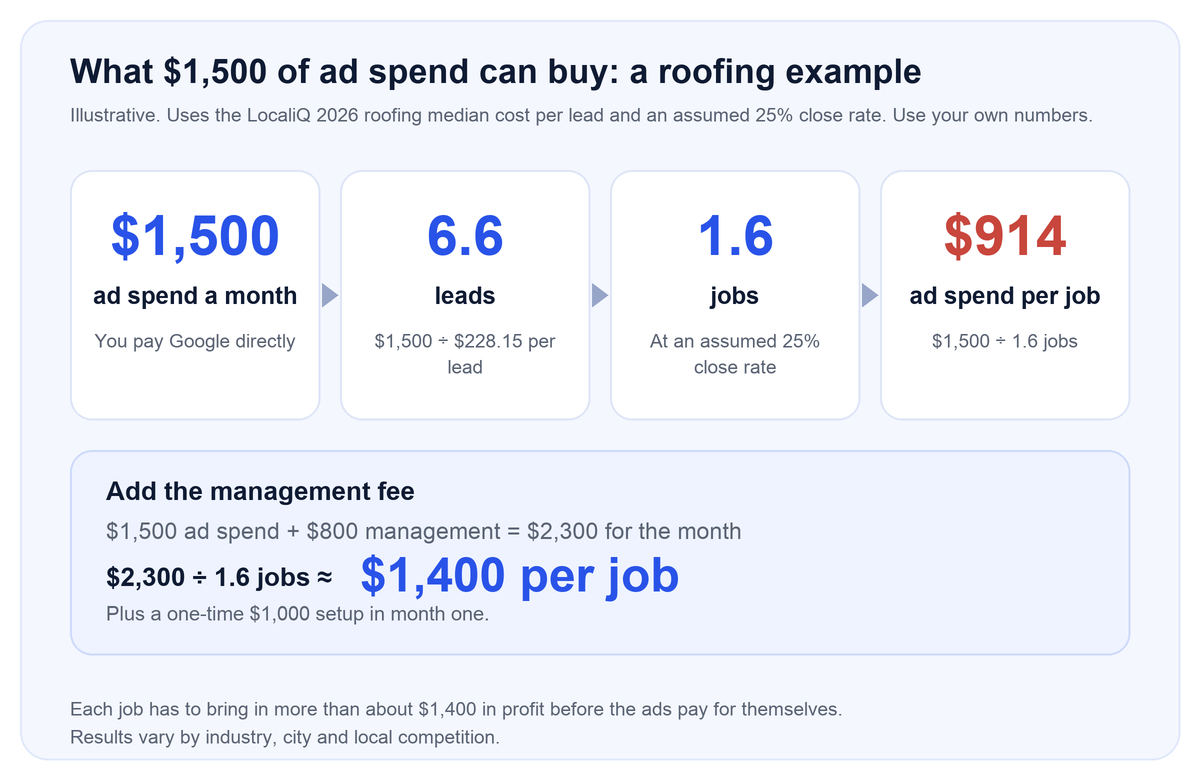
The formula: ad spend ÷ cost per lead × close rate = jobs. The close rate below is an illustrative assumption. Use yours.
Leads = $1,500 ÷ $228.15 ≈ 6.6 leads.
Assume 25% of leads become jobs: about 1.6 jobs, or roughly $914 of ad spend per job.
Add an $800 management fee: $2,300 for the month, about $1,400 per job, plus a one-time $1,000 setup in month one.
So each roofing job has to bring in more than about $1,400 in profit before the ads pay for themselves. The same $1,500 in a trade with a $93.69 median cost per lead (electricians) buys about 16 leads, but the jobs are usually smaller.
If the answer is under one job a month at your cost per lead, ads on that keyword may not pay. If your jobs are worth much more, they may pay well. That is why the same budget is a bargain for a remodeler and a bad bet for a small handyman. Judge any channel on cost per booked job, not cost per click.
How long each takes
- Google Ads: can send clicks within days once the account is approved and set up, followed by a learning period. Plan on a couple of weeks of data before you judge it.
- Local Services Ads: need verification before you appear. Google’s bidding page says it takes about two weeks to see accurate results once you are live.
- Local SEO: months. We found no verified universal timeline for map results. Agency blogs commonly say three to six months for first movement, but the ones we read give no data behind it. For general web pages, an Ahrefs study (May 2025) found 1.74% of newly published pages reached the top 10 within a year (6.11% in its filtered sample). That is organic web search, not the map pack, but it shows why nobody can honestly promise a date. Results vary by industry, city and local competition. Our own guide on what to ask a month-to-month local SEO company covers how to judge progress without a fixed timeline.
Local Services Ads vs Google Ads
- Payment. LSA charges per valid lead. Google Ads charges per click, call or no call.
- Control. Google Ads lets you choose keywords, wording and landing pages. LSA is simpler to run and gives you less control.
- Credits. Google reviews LSA leads automatically and credits ones it judges low quality, usually within 30 days. It no longer credits “job type not serviced” or “geo not serviced” leads, and manual disputes ended in 2024. Do not count on getting every bad lead back.
- Badge. Google replaced its separate Guarantee, Screened and License Verified badges with a single Google Verified badge on October 20, 2025, and ended the money-back guarantee tied to the old badge.
- Where it is going. Google is moving LSA into Google Ads as Performance Max campaigns with pay-per-lead goals. The first phase began in August 2026 with select US home and storefront service advertisers (plumbing, HVAC and roofing among them), more groups follow in late 2026, and other accounts in 2027. You still pay only for valid leads. Manual bids such as a maximum cost per lead are not supported after the move, and the old LSA dashboard becomes inaccessible, so back up your reports first.
Rules and screens change often, so check what applies to your account today. Our team can walk through what your trade is eligible for.
Where to start, by situation
| Your situation | Start with | Why, and the catch |
|---|---|---|
| Need jobs this month | LSA if your trade is eligible, or Google Ads, plus a cleaned-up profile | Speed. Watch cost per booked job, not cost per click. |
| Brand-new business, no reviews | Ads for calls, profile and reviews in parallel | Map ranking needs history and reviews, so SEO is slow at first. |
| Big, competitive city | Ads plus a long SEO plan | Top spots are slow to win and clicks cost the most. |
| Seasonal trade (roofing, paving, fence) | Ads at peak, SEO built in the off-season | Demand swings widely through the year. |
| Tight budget, $500 to $1,000 a month | Profile, reviews and website first, plus a small, capped LSA test if eligible | At a $7.85 average click, $300 a month (about $10 a day) buys roughly 38 clicks and, at the 7.33% median rate, about 3 leads. In roofing, $300 at the $228 median buys about 1. |
| Established, referral-heavy | Local SEO and profile first, ads for gaps | Protects your cost per job and fills slow weeks. |
| Large jobs, long research (remodels, additions) | Google Ads plus a strong site and profile | One booked job covers many clicks; buyers compare before they call. |
| Cash is not tight and you want both | Ads and local SEO together | Ads cover the gap, SEO lowers cost per job over time. |
Tools we offer for each: local SEO ($597 a month, website included, month to month), Google Ads management ($800 a month plus a $1,000 one-time setup, ad spend separate and we recommend at least $1,500 a month, about $50 a day, as a starting point), and Google Business Profile management. See pricing for what is included.
Wasted spend, agency fees and weak leads
Contractors raise the same worries again and again. We tried to read Reddit and trade forums for this guide, but Reddit would not open for us, so we are not quoting any thread. What follows comes from pages we could open.
- “My ads wasted money.” The cause is often searches that were never going to book: job seekers, DIY, supply-store queries. One agency guide claims HVAC accounts commonly waste 20% to 30% of budget this way, citing another agency’s guide. Treat that as a vendor claim, not a measured average. The fix is real: review the search terms report and add negative keywords such as jobs, DIY, free and parts.
- “The agency takes a percentage.” Percentage-of-spend pricing is common (10% to 20% in one 2026 pricing guide), and it rewards higher spend. Ask for the fee in writing and what it covers. Our Google Ads management is a flat $800 a month, so the fee does not rise when your spend does.
- “The leads are junk.” For LSA, Google filters spam and duplicates and credits some low-quality leads, but not wrong-job or wrong-area leads. For Google Ads, tight location settings and negative keywords do most of the work.
- “I cannot tell what worked.” Use a call log and a tracking number for each channel. One HVAC data study (2022, five contractors, 1,227 organic leads) found 82% of organic leads came through the Google Business Profile and 95% by phone, and argued that cost per lead is a poor yardstick for SEO because repeat customers calling in pull it down. Judge on booked jobs. See what the Google profile calls number means.
- “SEO takes forever.” Partly true, and nobody can promise a date. That is why we offer month to month with no setup fee.
Common mistakes
- No tracking. If you cannot tell which calls came from which channel, you cannot judge either.
- Missed calls. Paying for the phone to ring and not answering it. In LSA, answering fast also helps your ranking.
- Wrong areas. Ads or listings that reach places you do not serve.
- Skipping the profile. Ads and SEO both work harder on a complete profile. See the Google Business Profile checklist for contractors.
- Judging by clicks. Measure cost per booked job.
- Not reading the map. See where you show up block by block with how to read a Google Maps ranking map before deciding where to spend.
Frequently asked questions
If you need calls this month and can pay per lead, start with ads. If you can wait and plan to stay in business, build local SEO. Many contractors do both, because ads fill the gap while SEO builds.
It can be, especially if you plan to stay in business for years, because the work keeps paying after you stop paying us. It is slower than ads and not guaranteed. Ahrefs found only 1.74% of new web pages reached the top 10 within a year, so be wary of anyone who promises a date.
They can be when your job value covers the cost. LocaliQ puts the home services median at $90.92 per lead, with roofing at $228.15, and cost per lead rose for 69% of home services businesses in the year it measured. Work out cost per booked job first.
They can be for eligible trades, and you pay only for valid leads. Google suggests a budget for at least 10 leads a week, and gives about two weeks to see accurate results. Start with a capped budget and track booked jobs.
Local Services Ads charge per valid lead, are limited to eligible service categories and need verification. Google Ads charges per click and gives you control over keywords and wording.
Yes. You set a budget and pay for each valid lead. Once your monthly maximum is reached, the ad stops for the rest of the month unless you change the budget.
For most contractors it buys very little. At LocaliQ’s $7.85 average click, $300 a month is about 38 clicks and roughly 3 leads at the 7.33% median rate. In roofing it is about one lead. It works as a short test, not a lead engine. With our management we recommend at least $1,500 a month in ad spend (about $50 a day) as a starting point, not a ceiling.
$1 a day is about $30 a month, which is a few clicks at current prices. $20 a day is about $600 a month, roughly 76 clicks at the $7.85 average. Whether that is good depends on your cost per lead and job value, so use the formula above.
We cannot tell from outside your account. Check the billing page, the campaign budget and the spend by campaign, and confirm whether any campaign is a pay-per-lead one. If you cannot find it, ask for a review before more money goes in.
Not directly. Google says there is no way to pay for a better local ranking. Indirectly, the search terms report shows which phrases bring calls, which helps decide what to put on your site and profile.
General SEO helps pages rank for searches anywhere. Local SEO focuses on the map results and local searches, where Google weighs relevance, distance and prominence. Because distance counts, a map listing does not reach far past your service area.
It is a rule of thumb that a small share of the work drives most of the results, not a measured law. For a contractor, that usually means the Business Profile, reviews and a clear service page for each trade and city before anything fancy.
No. Google says there is no way to request or pay for a better local ranking.
Not sure where you stand? Request a free ranking report. We run both services and say plainly what is included: see services, how it works and pricing.
Sources
- Google: Tips to improve your local ranking
- Google Ads Help: how costs work
- Google Local Services Help: how leads work
- Google Local Services Help: how bidding works
- Google Local Services Help: automated lead credits
- Google Ads Help: Local Services Ads transition to Performance Max
- Search Engine Journal: LSAs moving into Google Ads (July 20, 2026)
- Search Engine Roundtable: Google Verified badge (August 21, 2025)
- LocaliQ: home services search advertising benchmarks (updated July 15, 2026)
- LocaliQ: search advertising benchmarks (updated June 1, 2026)
- Ahrefs: how long it takes to rank (May 2025)
- PipelineOn: local SEO vs Google Ads for home service contractors (June 2026, citing SearchLight Digital data)
- Outerbox Design: PPC management pricing (September 2026)
- Valley Marketing Group: negative keywords for HVAC and plumbing (June 2026)
- Data Driven Trades: how much revenue SEO generates for HVAC contractors (September 2022)
Last reviewed October 13, 2026. Cost figures are estimates and change often. Results vary by industry, city and local competition.